
The fast food industry has always thrived on rivalry, but this week the long running competition between McDonald’s and Burger King took an unexpectedly viral turn. What began as a simple promotional video quickly evolved into a social media moment that highlighted how modern brand battles are now fought not only in restaurants, but on TikTok and Instagram feeds.
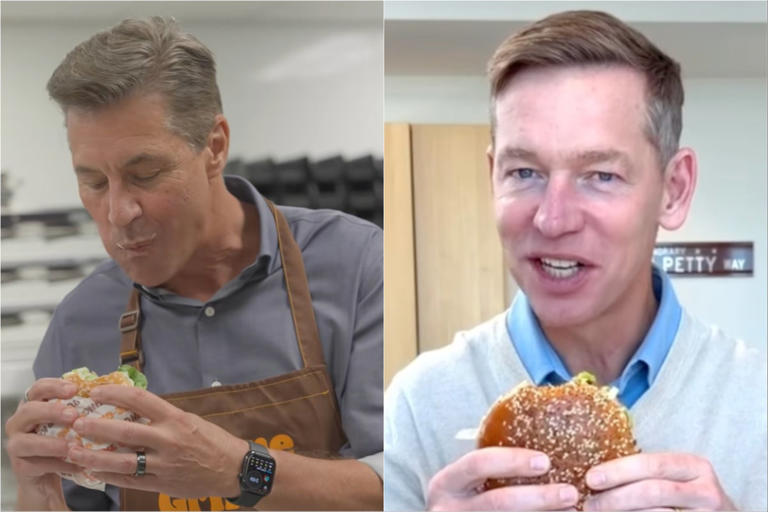
The spark came from McDonald’s CEO Chris Kempczinski, who appeared in a promotional video tasting the company’s latest menu addition, the Big Arch Burger. The burger, one of the largest items currently offered by the chain, was designed to signal a new era of bold menu innovation for the global fast food giant.
Instead, the video became a viral talking point for a completely different reason.
Viewers quickly began commenting on the CEO’s tentative first bite, joking that he appeared unsure how to approach the towering burger. Others suggested the moment felt slightly awkward, as if the executive was not entirely comfortable eating the product on camera. Social media users highlighted what many described as the “smallest first bite ever” for such a large burger.
Within hours the internet had done what it does best, turning the clip into a meme.
But it was Burger King that seized the marketing opportunity.
The rival brand posted its own video response featuring Tom Curtis, the president of Burger King U.S. and Canada, enthusiastically biting into the company’s signature Whopper. The tone of the clip was light hearted but unmistakably playful, with Curtis taking a confident bite before joking that the only thing missing was a napkin.
The caption accompanying the video simply read, “Thought we’d replay this.”
The response was immediate. Social media users quickly interpreted the post as a subtle jab at McDonald’s viral moment, with comments celebrating the playful rivalry between the two brands. Some viewers joked that the Burger King executive had demonstrated the kind of burger confidence the internet felt McDonald’s CEO lacked.
For brand strategists, the exchange highlights a broader shift in how major companies handle marketing in the age of social media. Viral moments are no longer tightly controlled campaigns. Instead, they are unpredictable interactions where brands must react quickly to shape the narrative.
Burger King has long embraced this approach. The company’s marketing teams have built a reputation for cheeky, fast moving social media responses designed to provoke conversation while keeping the brand culturally relevant.
McDonald’s, meanwhile, continues to focus on product innovation as it introduces the Big Arch Burger across markets. The item has already appeared in Canada and several European countries during testing phases and is now launching more widely in the United States. In some markets, including the United Kingdom and Ireland, it has already secured a place as a permanent menu item.
The burger itself is a substantial offering, containing over 1,000 calories and priced between $6.89 and $10.19 depending on location. McDonald’s describes it internally as the company’s “most McDonald’s burger,” combining the brand’s classic flavour profile with a larger, more indulgent format.
For Kempczinski, the viral moment may have brought unexpected scrutiny, but it also reinforced a simple truth about modern brand leadership. In an era where CEOs increasingly appear on social media and in promotional campaigns, every public appearance becomes part of the brand story.
And as the events of this week demonstrated, competitors are always watching.
In the fast food world, the battle for burgers is no longer confined to the kitchen. It is happening online, in real time, with millions of spectators.